Behind the scenes at hololive production, the VTuber agency managed by COVER, we also support VTuber activities as a "technology company," including streaming and motion capture technologies. Contributing to these efforts is the CTO Office, which looks after medium-term technology development across the whole organization and is necessary to support the technology used by all businesses.
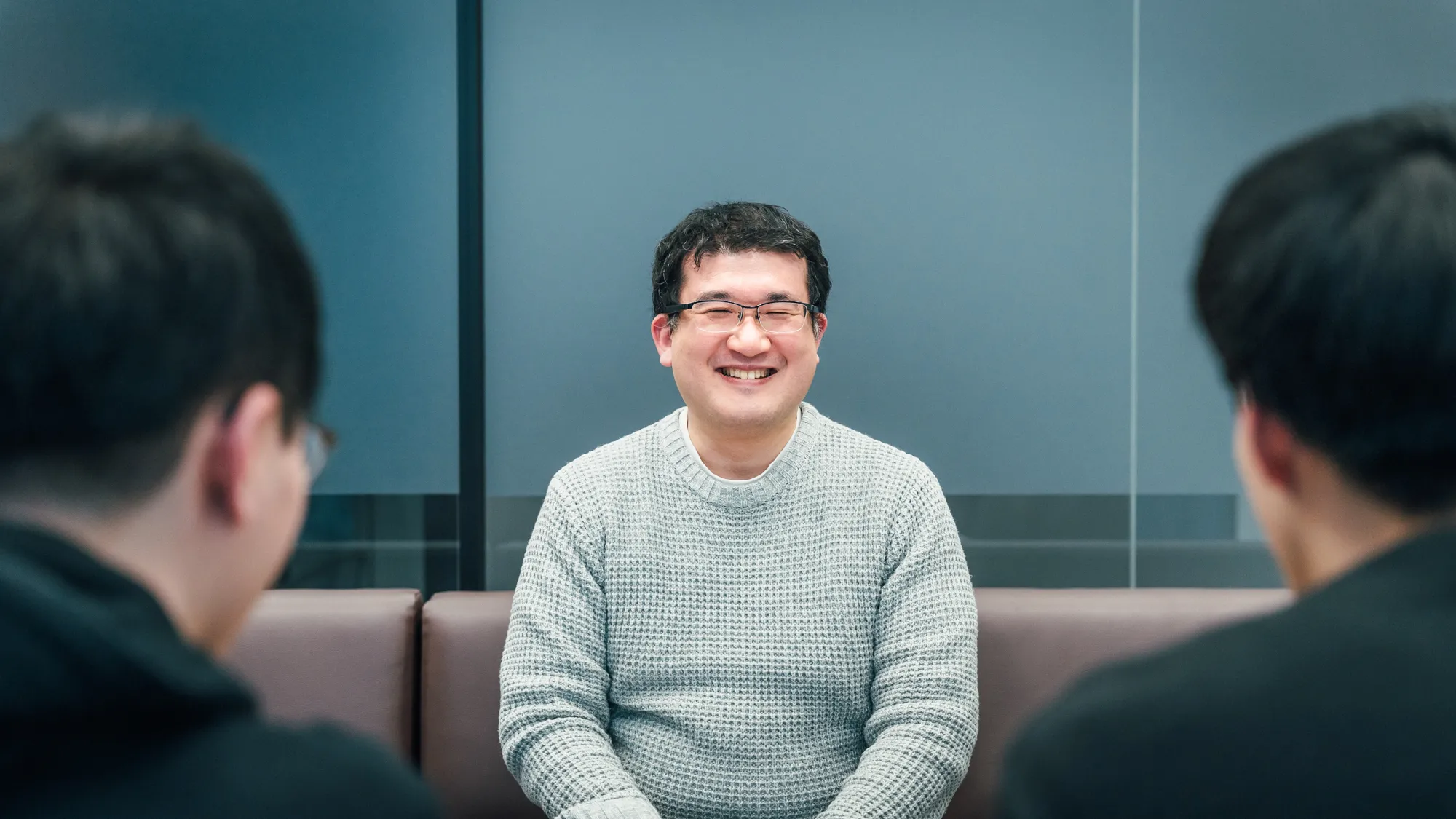
We spoke with CTO Ikko Fukuda, who has led technology strategy since the company's inception, and engineers A, who is in their third year, and K, who is in their first year in the CTO Office, respectively, after entering the company as graduates. We talked about the mission of the way the CTO Office works, the environment for developing younger employees, and what the engineers would like to achieve in the future.
Medium-term technological development across the organization: The CTO Office’s mission and structure
ーThere are a wide range of projects and businesses in COVER, including hololive, but what role does the CTO Office play? First of all, please tell us how the office was formed.
Each business handles product operations and immediate development, but medium-term technological development, looking years into the future, tends to get left by the wayside. The CTO Office was established to solve these issues and provide support across the entire organization using technology. We provide developmental support, create common platforms for use across the entire company, and conduct surveys and training from a medium-term perspective. We also write technology-related blogs and send out external communications regarding the holding of and participation in events for engineers. We currently have around 20 staff members in the office, separated into 4 teams: Research and Development, App Development, Infrastructure, and Data Analysis.
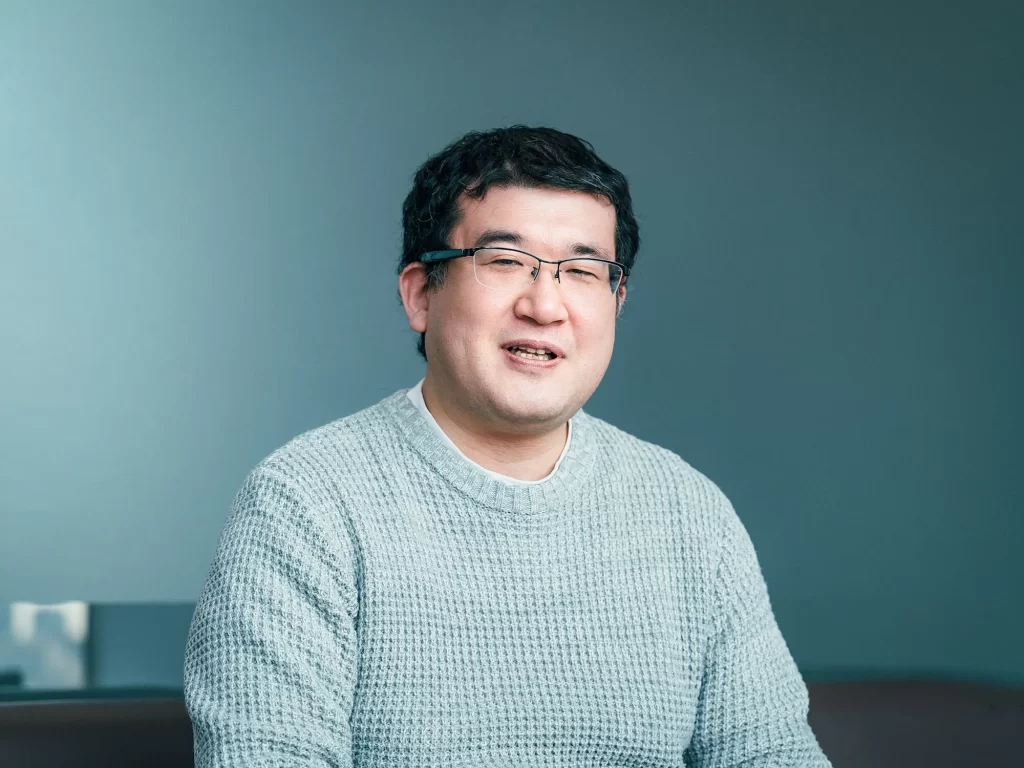
―How does the CTO Office coordinate with other departments?
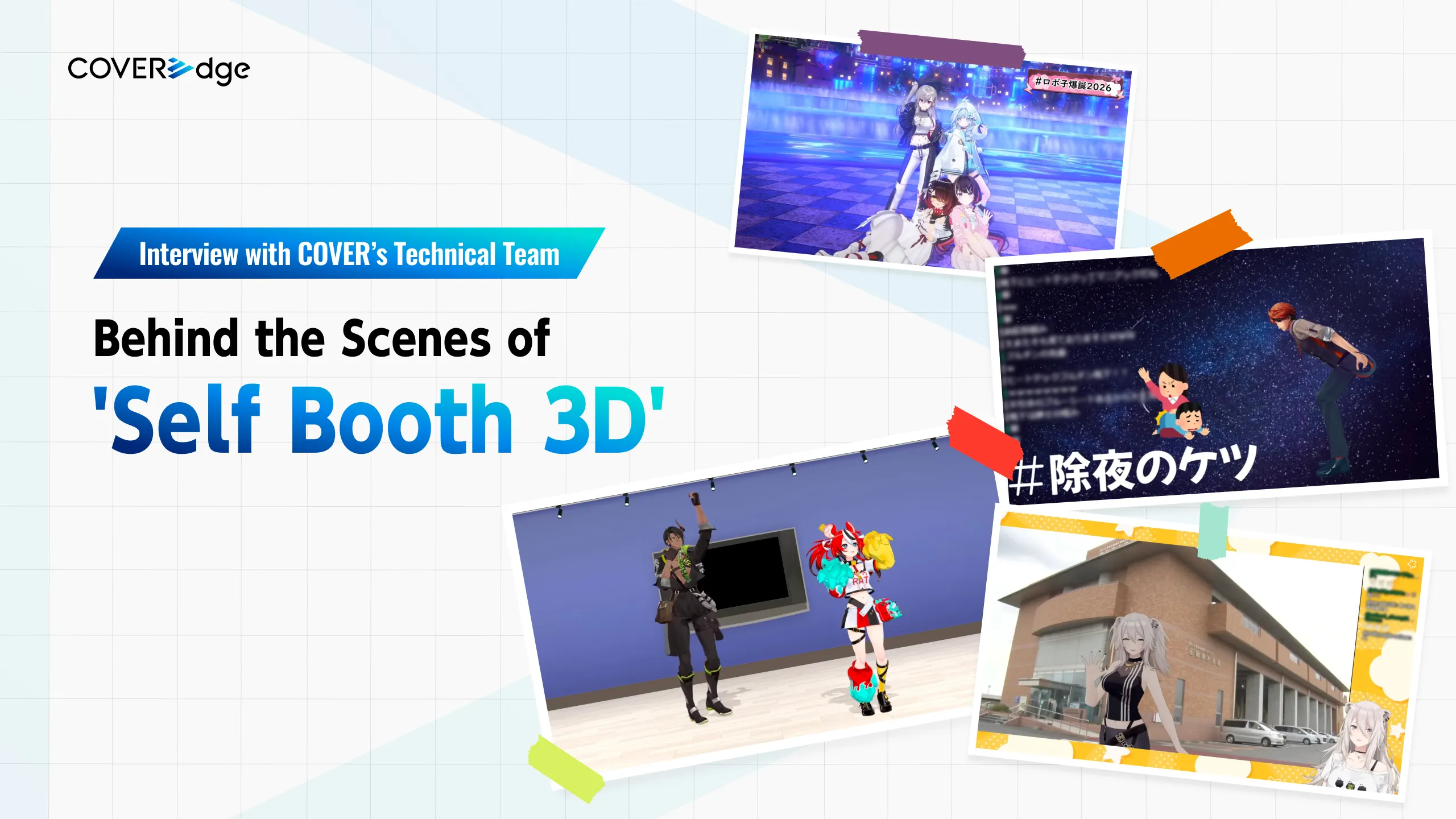
We coordinate with them in two major ways: the first being trialing new technology within the CTO office and proposing it to other business departments. We first formulate new technologies and propose them to departments, explaining that “we can introduce such and such with this goal in mind.” In the case of the introduction of markerless motion capture 3D Self Booths(available in Japanese only), CTO Office members found this technology, bought and transported the machines, and proposed and introduced to departments how they can be used. Another form of coordination is assigning CTO Office members to business department projects. The role our team members play is providing developmental support as experts and ensuring business departments are up-to-date on information from the CTO Office.
ーYou two entered the company as graduate employees, but could you please describe your roles in the CTO Office?
As you say, I entered the company as a new graduate, and this is now my third year. There are four members in my team, the Research and Development Team, all of whom specialize in different areas, including AI, infrastructure technology, and robotics. We mainly lead projects in the research phase and look after investigating and verifying new technologies from the perspective of “how could this technology be used?” As a Unity engineer, I am in charge of new app development and integrating avatar-related features for Holoearth, while also managing the verification of new AI technology, technology-related blogs, and managing internal LTs (lightning talks).
*LTs (Lightning Talks) are bimonthly short presentation events to encourage engineers to interact and share knowledge with other engineers from different departments throughout the company.
I am in my first year as a new graduate hire, and am in the Infrastructure Team. The role of the Infrastructure Team is to provide support for projects across all business departments and connect the entire organization. Currently, I am involved in the development of the official holoplus smartphone app as a backend engineer, and I am also in charge of login and voice post features for talents. We are also working on improving cybersecurity across the entire company.
—What is the atmosphere like in each of your teams?
As each member of the Research and Development Team specializes in a different area, we don’t focus on one task together, but rather work independently from each other and share knowledge at monthly team meetings. Collaboration across the division is relatively smooth when it comes to consulting others about technology-related matters, because others will be able to provide insights from a different perspective to me, as our areas of expertise are different. It is an environment where people are open to suggestions, such as “conducting this kind of research would be really useful.
Everybody in the holoplus project team, from the engineers to the content coordinators, is passionate about debating ways to have fans further enjoy our content to the point where it feels like a club activity. Those who are a part of our team are not isolated just because of the role they are in—we work in a highly dynamic environment where we are always looking for ideas to improve our products.
Connecting businesses transcending expertise: Foundations as a “technology company”
ーWhat activities did you pursue as a student, and why did you choose to join COVER? Also, were there any impressions you had of COVER before joining that are different since you started working with the company?
I was studying machine learning models that handled images at university, and wanted to use technology to bring interesting ideas to life. At that time, COVER wasn’t forthcoming with a lot of information on its technology, so I didn’t get the impression that it was an engineering company, and it wasn’t my preferred workplace. However, I happened to speak with Fukuda at a job fair, and learned that they were putting more effort than I had imagined into in-house development, which really piqued my interest. When I joined the company, I found that COVER was developing many more systems in-house than were visible externally, and I was once again surprised by how committed the company was to its technology.
I was researching IoT and cybersecurity at a technical college and university, and gained hands-on experience as an intern. The deciding factor for me to join COVER was actually Usada Pekora’s 1st solo live “USAGI the MEGAMI!!” at the end of 2023. I was originally a Usada Pekora fan, and the day after feeling all the emotions at the event, I had the opportunity to meet with Fukuda, after which I decided to join the company with that same enthusiasm. What I realized after joining was that I was in an environment where I could maximize the potential of each talent while respecting their individuality and freedom of expression through technology. As part of the development of holoplus, we are making sure to directly incorporate feedback from talents into feature improvements. I feel that having an environment where we can respect talents’ ideas and make technology a reality is amazing.
ーWhat is the significance of being heavily involved in projects from other departments while being a member of the specialized CTO Office?
In my case, I am providing app development support for Holoearth while belonging to the Research and Development Team, and I am mainly working as a Unity engineer. When necessary, I am sometimes required to have knowledge from the server side of things, and work directly with 3D models and shaders. Through a single project, I am gaining experience across different technological fields by doing work that would usually be handled by different engineers. Although the wide range of technology we need to learn about poses challenges at times, I am really enjoying the sense of fulfillment I get in being able to expand my skillset.
I am involved with holoplus from the Infrastructure Team, but I feel like I am a member of the holoplus team. The real significance in working like this is not only technologically speaking, but in the fact that it greatly increases the amount of interaction I have with other people. I have people asking me how to bring their ideas to life, engineering-wise, I can work while talking with other account teams, and it allows me to communicate with more people.

Creating an environment where young employees can challenge themselves with autonomy: Trusting employees in their first year
―Have there been instances where proposals from young employees have become a reality, or have you had experience being tasked with projects requiring a high amount of discretion?
Yes, I have. With holoplus, I was in charge of the account infrastructure for the hololive English twin talents Fuwawa Abyssgard & Mococo Abyssgard, from hands-on proposals to design and implementation. In the beginning, it was planned that we design completely independent accounts for both of them, but we considered the fact that their being twins was part of their identity, so I proposed the idea that for the authentication platform that we have separate accounts, but on holoplus we have a system where two people can log into the one account. My idea was used, and I was in charge of it from the design phase up until it was implemented. Even though it is my first year after graduating, my proposal was accepted as it was ideal for the fan experience, and being in charge of the project right up until completion gave me a lot of confidence.
In my case, right after I joined the company, I had the great experience of leading the development of the AI agent “AI Koyori“(available in Japanese only). I remember being surprised that I was being entrusted with such a project just months after joining. We are in an environment where we can demonstrate our abilities if they align with a particular project, and I feel that this freedom directly correlates to our growth.
We absolutely welcome those who work independently, regardless of what career they have had. For me, the experiences I had when I was younger with trial and error have made me who I am today, so I want my team members to have the same experiences of taking on jobs that require a large amount of discretion, no matter how little. When we asked A to take on 3D tasks that were not in their field of expertise, we took a flexible approach without any fixed ideals, which yielded great results. We see not having any experience as a weapon because, on the flipside, it allows for unique perspectives.
―What do you find most interesting about working as an engineer in an environment like at COVER?
You have the chance to challenge yourself in areas you aren’t so strong in. An example of this would be when we provided support using in-house technology during Hoshimachi Suisei’s appearance on “THE FIRST TAKE.” We had to develop special technology for this performance as it was a talent who typically exists virtually singing and moving in a real-life space. What is really uniquely interesting about working at COVER is that, as we are supporting the talents directly using technology, we have the opportunity to create things that have special requirements, or that wouldn’t typically be a product.
I feel that the work is worthwhile when features that I’ve created become part of talents’ and fans’ daily lives. After releasing the holoplus voice post feature, I was really glad to be involved in the development seeing voice content from talents being sent on a daily basis. However, I do encounter critical issues such as extreme traffic spikes on the regular. We have previously had traffic spikes that massively exceeded our expectations when talents introduced holoplus to their fans on stream, causing the app to be unstable. This reminded me of the weight of responsibility I have to support this level of enthusiasm, along with a sense of guilt. Creating systems that can manage high amounts of traffic like this is a very rewarding challenge for us engineers.
For regular services, after something is released, servers gradually experience more traffic, but in the case of hololive, it is unique in the fact that the instant a talent starts streaming, the servers are flooded with hundreds of thousands of people trying to access them within seconds. How do you control this sudden stress on the system and optimize the fan experience? This is a rather difficult question for infrastructure engineers, but is one that we wouldn’t get to experience in many other places.
ーPlease tell us about the new graduate development support system at COVER.
When I joined the company, it was mostly OJT (on-the-job training), but having a mentor, who would review our code and answer any questions we had, assigned to us was mandatory. One-on-ones and job rotations have now been introduced, meaning there is now more organizational support than ever.
I also have a one-on-one with my mentor once a week, which is not only for technology-related guidance but for goal-setting support as well. Also, from when we joined onward, we also underwent external graduate engineer training with engineers from other companies. What was particularly memorable was the *ISUCON training where we were divided into random teams and challenged to improve app performance, and the insights that I gained have been directly relevant to my current work on measures and improvements regarding holoplus server loads. (Read the article on graduate engineering training here – available in Japanese only)
*ISUCON is an event for engineers who compete to improve the performance of a given web application.https://isucon.net/
“I want to provide experiences where fans are glad to support their oshi: The future of the CTO Office
―What does the CTO Office want to achieve using the power of technology, and what does the future of entertainment look like?
Since I’ve joined the company, I have had a wide range of experiences such as engineering from the client to the server side, to technology PR activities. In the future, I would like to use my diverse experience to further hone the expertise that is central to me, and become a leader in the technology space at COVER. I would also like to provide talents with the technology to be able to produce entertainment with intrinsic value that doesn’t fade for decades and doesn’t just chase the latest social trends, as well as use the power of technology to create positive experiences where fans will one day look back and think, “I’m glad I supported hololive.”
I want to be an engineer who isn’t forced to give up due to technological restraints when a talent wants to try something. I mainly handle infrastructure right now, but I would like to widen that scope to include areas that are more directly content-related. I hope to one day have people tell me, “If you’re here, K, we can make anything,” and continue to preserve the simple joys in life as someone who provides life-changing moments for others while making sure to maintain my perspective as a fan.
It is really reassuring to hear those words from you two. Our top priority in the CTO Office is using technology to maintain a”sense of realism” when it comes to the VTubers. How can we use technology to make fans feel like the talents do really exist? From streaming environments to exploring new expressions, it is all about enriching the time talents and fans spend together. We hope to continue to support talents using technology without losing sight of this point, so they can shine brighter for longer, and search for forms of sustainable entertainment.
―Lastly, what is your true impression of COVER?
Somewhere where you can take on interesting challenges, no matter what it is. Many years have passed since VTuber culture has emerged, and now tracking technology and the quality of video content, technology that was once seen as astounding, has now become run-of-the-mill. However, at COVER, we are not satisfied with just “run-of-the-mill”; we are constantly pushing the boundaries to further improve expressions, and asking ourselves, “Could we deliver more surprises if we combine these new technologies together?” Lately, there has been a growing sentiment that individual VTuber technology is now quite powerful and is catching up fast, but we know that there is also value in medium-term research and development as a company with such capabilities. There are many challenges that I cannot share here but I hope we can continue to surprise.
I think COVER is a club with a professional mindset. When I was a student and really into robot contests, the moments where I would brainstorm and formulate ideas with my friends were some of the most fun I’ve ever had. Developing holoplus now is honestly similar in that, regardless of the engineer or the content coordinator, we are able to have lively discussions about how to make things better while shouldering the responsibility to produce the best results. What is special about COVER is that, even as an adult, I still get to experience that excitement in my professional work life.
Put simply, a return to humble beginnings. The bigger an organization gets, the more I’ve come to realize the importance of going back to the basics. VTuber culture was born from streaming, where talents and fans can interact with each other, and has developed into what it is today. Our pursuit of the latest technology and the building of the largest-scale systems is for no more than to enrich and solidify these fundamental principles, so we must always remember why we are refining our technology, and we hope to continue to support these spaces that talents and fans share for many years to come.